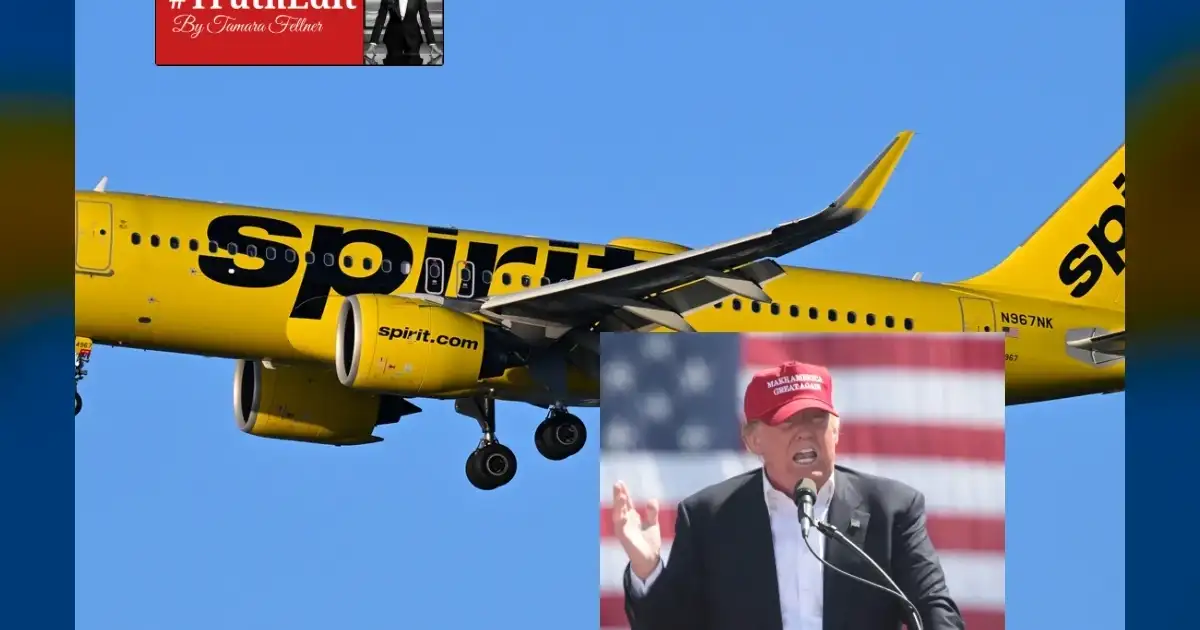

The moment Spirit Airlines’ entire fleet grounded to a halt, President Donald Trump didn’t just see a corporate collapse; he saw a political weapon. With surgical precision, he pinned the blame squarely on former President Joe Biden, launching the opening salvo in what promises to be a brutal economic war ahead of the 2026 election cycle.
Spirit Airlines didn’t just cancel flights; it evaporated, stranding thousands nationwide in an instant. The Trump administration, ever the opportunist, wasted no time, swiftly declaring Biden’s economic policies the unequivocal root cause of this aviation catastrophe.

In a masterclass of crisis management, President Trump himself “personally intervened,” his team scrambling to coordinate with rival carriers like Delta to offer meager vouchers. “Yet another Biden mess,” declared Secretary Duffy, a soundbite meticulously crafted for maximum political impact.
Biden’s Economic Legacy Under Fire
For months, Trump and his loyalists have systematically dismantled former President Biden’s economic legacy, relentlessly hammering his administration’s “unprecedented” federal spending. Their core contention: this fiscal largesse directly ignited a dangerous surge in the national debt, a ticking time bomb for the American taxpayer.
The nation currently grapples with the suffocating grip of persistent inflation and elevated interest rates, a double blow to American households. Trump doesn’t just assert these are consequences; he declares them the inevitable and direct fallout of Biden’s disastrous tenure in the Oval Office.
Now, the Spirit Airlines debacle isn’t merely a corporate failure; it’s a potent, visual symbol of economic instability, a gift-wrapped opportunity for the Trump administration. They are not just seizing the moment; they are weaponizing it, cementing their pre-2026 election narrative with ruthless efficiency.
The Political Playbook in Action
Make no mistake: the timing of this political theater is meticulously calculated. As the 2026 election cycle begins to hum, economic policy isn’t just a talking point; it’s the undisputed, scorched-earth battleground where votes will be won or lost.
Blaming a predecessor is the oldest trick in the political book, a reliable maneuver to deflect public fury and conveniently recast the current administration as the heroic savior of inherited woes.
President Trump, ever the showman, is masterfully positioning himself as the decisive, hands-on leader, the one who doesn’t just manage a crisis but conquers it. This carefully cultivated image, a stark contrast to perceived government paralysis, is designed to resonate deeply with a disillusioned electorate.
This isn’t merely about Spirit Airlines; it’s a calculated diversion. The administration is aggressively channeling voter anxiety towards economic woes, a strategic gambit to solidify the Republican platform and obscure any inconvenient narratives.
The Hypocrisy Unmasked
Yet, beneath the administration’s carefully constructed narrative, a palpable cynicism simmers among the public. Online critics, armed with inconvenient facts, have been merciless in exposing a glaring hypocrisy: Spirit Airlines’ financial woes are hardly a new development.
During Trump’s previous term, Spirit, teetering on the brink, actively begged his administration for a bailout. A crucial detail often overlooked: GOP lawmakers, citing free-market principles, summarily torpedoed that rescue package, rejecting the airline’s desperate plea for federal assistance.
Now, the very administration that once left Spirit to twist in the wind suddenly swoops in, playing the benevolent hero, coordinating with rival airlines for those same vouchers. For many astute observers, this sudden, performative concern rings not just hollow, but utterly cynical.
One X thread, exploding with over 20,000 likes, captured the public’s outrage perfectly:
Hypocrites: blocked their own rescue, now play hero coordinating with Delta et al. for vouchers.
This isn’t merely sentiment; it’s a scathing indictment of transparent political opportunism.
Spirit’s Deeper Troubles
Spirit’s collapse was no sudden implosion, no bolt from the blue. This was a long, agonizing decline, punctuated by a documented history of financial instability, multiple bankruptcy filings, and crippling blows from volatile fuel price spikes.
Beyond the balance sheets, Spirit was infamous for its “trash service” – a moniker earned through years of relentless customer complaints about abysmal experiences. These deep-seated internal dysfunctions, far more than any external policy, were the true architects of its ultimate demise.
Crucially, the blocked JetBlue-Spirit merger in March 2024 ripped away a desperately needed lifeline, sealing the carrier’s fate. These are not minor footnotes; they are fundamental, long-standing factors that either predate or operate entirely independently of any current White House policies.
To suggest Biden’s economic policies alone triggered this immediate shutdown is not just an oversimplification; it’s a deliberate distortion, a cynical attempt to reduce a complex corporate failure into a convenient political talking point.
Who Really Pays?
The immediate, brutal cost of this corporate implosion falls squarely on the shoulders of thousands of stranded flyers. Their canceled plans, lost money, and utterly disrupted lives fuel a palpable fury that boils over across every social media platform.
From endless airport queues to non-existent refunds, the “Spirit’s chaos” became a bitter epitaph for countless travelers. This traumatic experience doesn’t just breed frustration; it cultivates a deep, lasting distrust of the entire airline industry, a sector already struggling with public confidence.
Beyond the individual horror stories, the broader economic ripples are undeniable. The sudden collapse of a major airline sends shockwaves through the market, signaling not just instability, but a deeper malaise that erodes investor confidence and casts a long shadow over the job market.
Yet, in this landscape of disruption and despair, one group invariably profits: the political class. This crisis isn’t a problem for them; it’s a potent, ready-made talking point, a fresh cache of ammunition to fire at an opponent’s economic record.
As one widely shared online comment succinctly put it:
Both parties suck, airlines are cartel anyway.
This isn’t merely a jaded view; it’s a raw expression of public disillusionment, a stark belief that powerful interests always win while ordinary people are left to pick up the pieces.
The administration’s “swift action,” while superficially appearing helpful, is a meticulously choreographed political performance. It’s designed to allow President Trump to project an image of decisive competence, cementing his persona as the only leader capable of “getting things done” amidst chaos.
Ultimately, this entire spectacle has little to do with genuine airline industry reform or the plight of the stranded traveler. It is a cynical, calculated exercise in scoring political points before a crucial election. And as always, the American taxpayer, caught between corporate failure and political opportunism, is left to foot the bill for this relentless, high-stakes political theater. The question remains: when will the curtain finally fall on this act of calculated blame, and who will be left standing in 2026?
Source: Google News