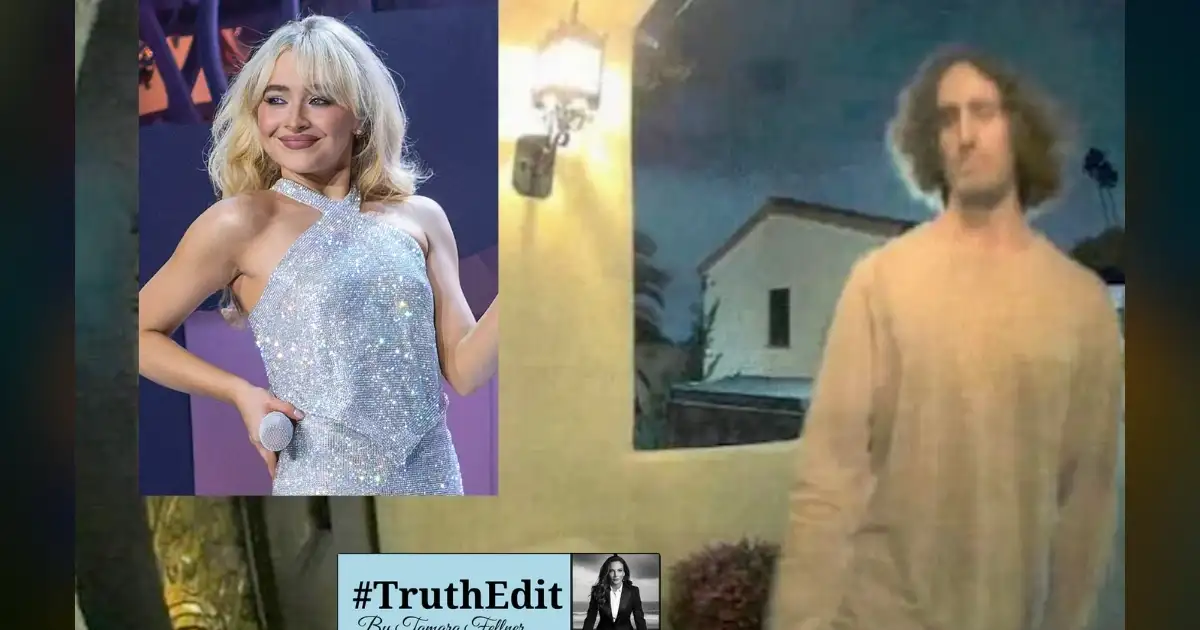

The gilded cage of celebrity, it seems, offers little sanctuary from the darkest corners of human obsession. Pop sensation Sabrina Carpenter has just been brutally reminded of this truth, compelled to seek a temporary restraining order against an alleged stalker whose fixation has curdled into a tangible threat.
This desperate legal maneuver follows a terrifying breach: an individual reportedly captured on video brazenly trespassing at Carpenter’s Los Angeles home on Sunday, May 31, 2026. Security footage, now grim evidence, allegedly depicts attempts to force entry into her private residence. More chilling still, the alleged stalker left behind a trail of unsettling notes and personal items, a grotesque violation that transcends mere property damage to strike at the very core of her privacy and sense of safety.

The Los Angeles Superior Court, recognizing the immediate and credible danger, moved with commendable swiftness, granting the temporary restraining order on Monday, June 1, 2026. This judicial decree now legally compels the alleged stalker to maintain a significant distance from Carpenter – a wide berth that encompasses her home, her workplace, and any venues where she performs. Law enforcement has confirmed an active, high-priority investigation into potential felony stalking, while Carpenter’s representatives have stated unequivocally that she is "deeply disturbed" and singularly focused on fortifying her personal security.
The Paper Shield: How Far Does a Restraining Order Reach?
Restraining orders, in their essence, are designed to be a legal bulwark against harassment and violence. Yet, one must ask: how robust is a barrier made of paper against the relentless tide of a determined, delusional mind?
The unfortunate, often tragic, reality is that a court order, while carrying the full weight of the law – triggering arrest and prosecution for violations – is not a physical deterrent. It is not a bulletproof vest, nor a fortified wall.
History, in its bleakest chapters, offers a troubling, repetitive narrative. Despite these legal protections, stalking cases are plagued by alarmingly high violation rates.
Stalkers, often driven by a distorted sense of entitlement or a complete disconnect from reality, frequently disregard such orders. This forces victims, particularly public figures like Carpenter, into an exhausting, terrifying cycle of constant vigilance, repeated legal battles, and the agonizing uncertainty of when the next boundary might be breached.
The law provides a framework, yes, but it offers no guaranteed physical barrier, only the promise of consequence after a violation has occurred.
"Ms. Carpenter is deeply shaken by this incident and is committed to ensuring her safety and privacy. We are grateful for the swift action of law enforcement and the court, but the emotional toll of such a violation cannot be overstated," a representative for Sabrina Carpenter told TMZ, emphasizing the profound personal impact.
This incident, regrettably, is far from an anomaly. It is merely the latest entry in a grim ledger of celebrity nightmares.
From the relentless pursuit of Taylor Swift to the chilling threats faced by Billie Eilish and Selena Gomez, the pantheon of pop royalty is rife with tales of obsession turned dangerous.
The legal system, for all its necessary tools, remains in a constant, often losing, struggle against the insidious nature of relentless fixation. The order offers a legal framework, a declaration of boundaries, but it is not, and never can be, a guaranteed physical barrier against a mind unmoored.
Beyond the Courts: Celebrity Security in the Digital Age
For stars existing in the treacherous waters of public life, legal protections are merely one, often permeable, layer of defense. The stark reality dictates a far more extensive, resource-intensive approach: heavy investment in sophisticated private security.
This isn’t just a guard at the gate; it’s an intricate web of armed personnel, state-of-the-art surveillance systems, biometric access controls, and meticulously secured perimeters. Some even maintain a network of discreet safe houses, demonstrating the constant, pervasive threat.
These elaborate, often invisible, measures become the primary physical deterrent, a necessary arms race against the dark side of adoration.
The digital realm, an omnipresent extension of modern life, adds another, arguably more insidious, layer of vulnerability. Social media, with its curated glimpses into personal lives, and the readily available trove of online information transform celebrities into disturbingly easy targets.
Their highly specialized teams work tirelessly, often thanklessly, to minimize public access to personal details, scrubbing the internet clean of anything that could be weaponized. They meticulously restrict geotagging, employ sophisticated algorithms to monitor online discussions for potential threats, and track digital footprints that might signal escalating obsession.
Digital stalking, a precursor to physical incidents, has become an alarmingly common phenomenon, rendering online vigilance not just crucial, but a matter of survival.
The entertainment industry, in its current iteration, has witnessed an undeniable, alarming surge in these cases. The ease with which obsessed individuals can track, harass, and ultimately threaten public figures is a stark, unsettling reminder that fame, for all its glittering allure, comes with an exorbitant, often dangerous, price.
No amount of critical acclaim, chart-topping success, or global adoration can insulate one from the chilling, predatory underbelly of fanaticism. The very platforms designed for connection become conduits for menace.
"We are actively investigating a reported trespassing incident at Ms. Carpenter’s residence. Due to the ongoing nature of the investigation, we cannot provide further details at this time, but we take all such threats very seriously and are working closely with Ms. Carpenter’s team," an unnamed Los Angeles Police Department spokesperson commented to Variety, underscoring the gravity of the situation.
The Unseen Toll of Obsession
The psychological impact of stalking is immense, a corrosive force that erodes peace of mind and shatters the illusion of safety. Victims, irrespective of their public status, endure profound trauma, pervasive fear, and an unbearable invasion of their most sacred space.
Carpenter’s team noting she is "deeply disturbed" is not mere public relations boilerplate; it highlights the severe mental health burden that inevitably accompanies such terrifying incidents. This isn’t just about property; it’s about the sanctity of one’s inner world.
Constant, gnawing fear becomes an unwelcome, daily companion. The chilling sensation of being watched, of having one’s sanctuary violated, is profoundly unsettling, sparking hyper-vigilance and a pervasive sense of paranoia.
Even when legal battles are won, when the stalker is temporarily deterred, the emotional scars remain, often requiring extensive psychological support to cope with the relentless stress and the enduring sense of vulnerability. The very concept of ‘home’ is irrevocably altered, transformed from a haven into a potential battleground.
This incident forces us, as a society, to confront the true, often hidden, cost of celebrity. It serves as a harsh, unvarnished lesson for fans and the public alike: admiration, when left unchecked, can twist into something monstrously dangerous.
The line between devoted admirer and dangerous stalker is terrifyingly thin, a precipice over which too many have fallen. The legal system, in its imperfect wisdom, endeavors to delineate and enforce that line, but for those living perpetually in the public eye, it is a constant, exhausting, and often harrowing battle for a fundamental human right: the right to feel safe in one’s own skin, in one’s own home.
Sabrina Carpenter’s harrowing ordeal is more than just a celebrity news item; it is a stark, uncomfortable mirror reflecting a critical truth about our culture. Fame, while bestowing immense privilege and opportunity, simultaneously strips away the most basic tenets of privacy and personal safety.
Restraining orders are a necessary first step, a legal declaration of boundaries, but they are far from a complete solution. The fight for personal security, for the ability to live without constant fear, is an ongoing, harrowing struggle for those who, by their very profession, entertain and inspire us.
It is a price no one should have to pay, and a societal problem we are only beginning to truly grapple with.
Source: Google News