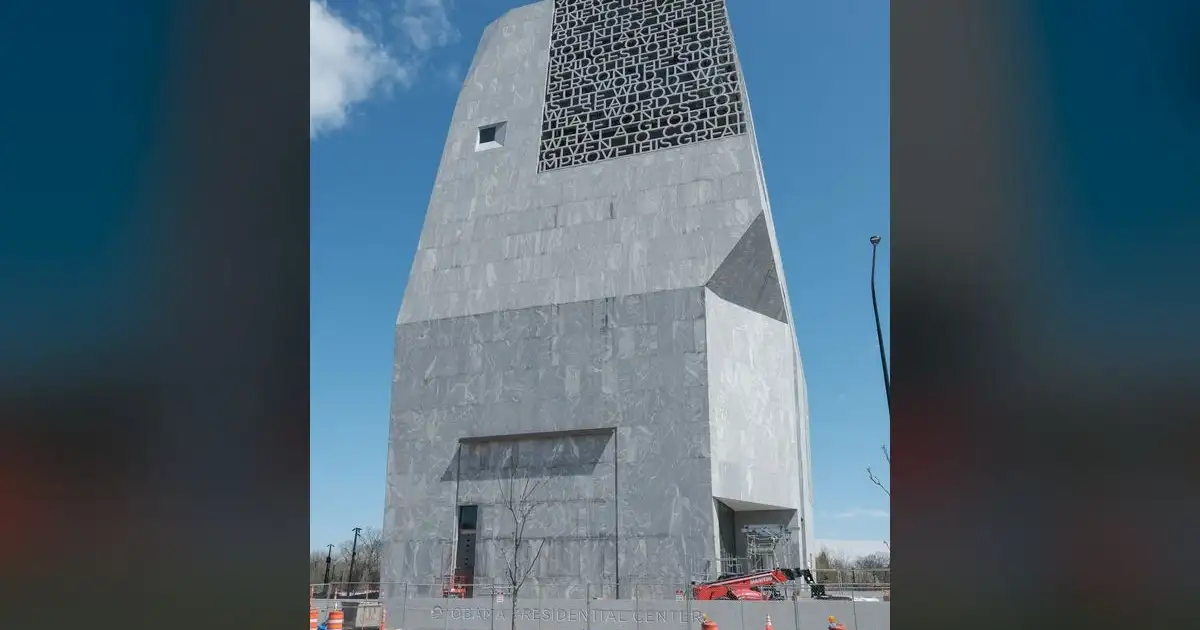

President Donald Trump has once again launched a tactical strike, slamming Barack Obama’s controversial $850 million presidential library with a grim, almost apocalyptic vision. Trump didn’t just criticize; he painted a chilling picture of the center surrounded by homeless camps within a decade, a direct and brutal challenge to Obama’s legacy and the very future of Chicago’s urban landscape.
This isn’t mere political posturing; it’s a strategic broadside aimed squarely at the Obama Presidential Center, currently rising in Jackson Park on Chicago’s South Side. Trump’s audacious prediction rips open deep-seated anxieties, questioning the fundamental efficacy of colossal urban development projects and the promises they carry. The $850 million project, entirely privately funded and slated for completion in 2026, is touted as a beacon of revitalization. But Trump’s cynical vision demolishes that carefully constructed narrative, forcing a stark confrontation with urban realities.

The Battle for Chicago’s South Side: A High-Stakes Game
The Obama Presidential Center is far more than just a library. It’s a sprawling complex featuring a museum, an athletic center, and various community spaces. Proponents champion it as a transformative force for the South Side, promising a colossal economic injection: 5,000 construction jobs, 2,500 permanent positions, and a projected annual economic impact for Chicago estimated at a staggering $3.1 billion.
“The Obama Presidential Center will be a dynamic hub for community engagement and a global destination that inspires visitors to make a difference in their own communities.”
— Valerie Jarrett, Board Chair, Obama Foundation
That’s the official game plan, a vision that sounds like an undisputed touchdown for a struggling area. Yet, on the ground, not everyone is buying the hype. The grand pronouncements of revitalization often clash with the lived experiences of long-time residents, who view such projects with a wary eye, having seen similar promises fall short or benefit only a select few.
The Unseen Opponents: Gentrification and Displacement on the Horizon
Trump’s attack, while undeniably politically charged, strikes a nerve by echoing legitimate community fears. Is the Obama Presidential Center truly poised to uplift local residents, or could it inadvertently become an engine of their displacement? The answer, for many on the South Side, is a brutal reality check. Community groups have voiced their skepticism and demands since day one, understanding that good intentions alone are not enough.
- The Obama Community Benefits Agreement (CBA) Coalition has been a persistent and vocal critic, consistently raising alarms about the project’s potential downsides.
- They argue, with compelling evidence from other urban developments, that this massive investment could accelerate gentrification at an alarming pace.
- Without robust protections, increased housing costs will inevitably force out low-income residents, shattering established communities.
- Neighborhoods like Woodlawn and South Shore, already facing economic pressures, are particularly vulnerable to these market forces.
The absence of a legally binding Community Benefits Agreement leaves these fears not just legitimate, but urgent. The Center could indeed bring prosperity, but the critical question is: prosperity for whom? Many worry it will price out the very residents it purports to serve, leaving them stranded on the sidelines of their own community’s supposed revival. It’s a bitter pill to swallow when a project meant to honor a local hero inadvertently exacerbates existing inequalities.
“We need legally binding agreements for affordable housing and local hiring, not just grand museums. What good is a beautiful library if the people who need it most can’t afford to live nearby, if they are pushed out of their homes?”
— Jawanza Malone, Executive Director, Kenwood-Oakland Community Organization (KOCO) and Obama CBA Coalition member
This isn’t merely about the physical structure of the library; it’s about the equitable distribution of its benefits and the social contract between developers and the community. Chicago already grapples with a severe homelessness crisis, with thousands experiencing the brutal reality of living without stable shelter daily. This problem is fueled by a chronic shortage of genuinely affordable housing. These are the hard, undeniable truths on the ground, truths that a monumental project must address, not ignore.
Trump’s Playbook: Attacking the Legacy, Exploiting the Vulnerable
Trump’s comments fit seamlessly into his well-established political playbook. He consistently targets and questions Democratic initiatives, aiming to diminish the achievements and legacy of his predecessors. Depicting the Obama library as a future homeless hub is a calculated, cynical maneuver. It frames the project not just as a failure of urban planning, but as a symbolic failure of liberal policy itself.
This isn’t about genuine concern for urban development or the homeless crisis. This is pure political football. Trump skillfully uses images of urban decay and social strife to score points with his base, appealing to those who view big cities as mismanaged bastions of liberal excess. It’s a classic strategy: highlight a problem, assign blame to political opponents, and conspicuously offer no concrete solutions or actionable plans. It’s a rhetorical weapon designed to inflame divisions, not to solve complex issues.
Is he exploiting a serious social issue for political gain? Absolutely. Homelessness advocates across the nation would tell you that this kind of rhetoric is not only unhelpful but actively harmful. They demand systemic solutions, comprehensive funding for housing, mental health services, and job training—not political theater that sensationalizes suffering. Trump’s remarks are a cynical exploitation, a deliberate deflection from the real, hard work needed to address the crisis of homelessness with dignity and efficacy.
The Real Stakes for Chicago: A Defining Moment
The Obama Presidential Center promises a significant economic boost, a potential anchor for revitalization. Yet, the city’s homelessness problem and affordable housing crisis are a stark reality that cannot be ignored. The critical, defining question remains: Will the Center truly be an inclusive benefit, a rising tide that lifts all boats in the community? Or will it, despite its noble intentions, become a potent symbol of displacement, a monument to gentrification?
The Obama Foundation has made efforts to acknowledge and address community concerns, launching various affordable housing initiatives. However, the efficacy and scale of these efforts are continuously debated. Without a robust, legally binding Community Benefits Agreement, the risk of gentrification and the subsequent displacement of long-time residents looms large, a persistent threat to the integrity of the South Side. This isn’t just a high-stakes game for Chicago’s economic future; it’s a battle for the soul of its neighborhoods.
This isn’t merely about constructing a building; it’s about the very fabric of a community. It’s about whether a monumental project, conceived with the best of intentions, truly uplifts everyone within its orbit, or if it inadvertently leaves the most vulnerable behind, creating a legacy fraught with unintended consequences.
The Final Drive: A Legacy on the Line
Donald Trump’s harsh prediction about the Obama Presidential Center is, at its core, pure political theater—a calculated move to weaponize a serious urban problem against his predecessor. But his rhetoric, however cynical and divisive, spotlights an uncomfortable truth that urban planners and community leaders cannot afford to ignore. Large-scale development projects, even those with the most laudable intentions, possess the inherent power to exacerbate existing inequalities if not managed with meticulous care and a deep commitment to social justice. The real test of the Obama Presidential Center, and indeed of Chicago’s leadership, is not simply whether the library gets built, but whether the South Side residents—all of them—truly win from the deal. Will it stand as a genuine beacon of opportunity and inclusion, or will it become a stark monument surrounded by the very problems it claimed to solve, a testament to a legacy that fell short of its promise?
Photo: Wikimedia Commons (query: Chicago)
Source: Google News