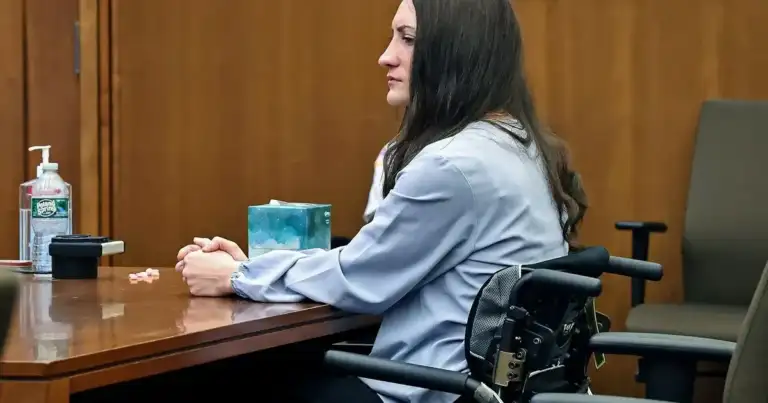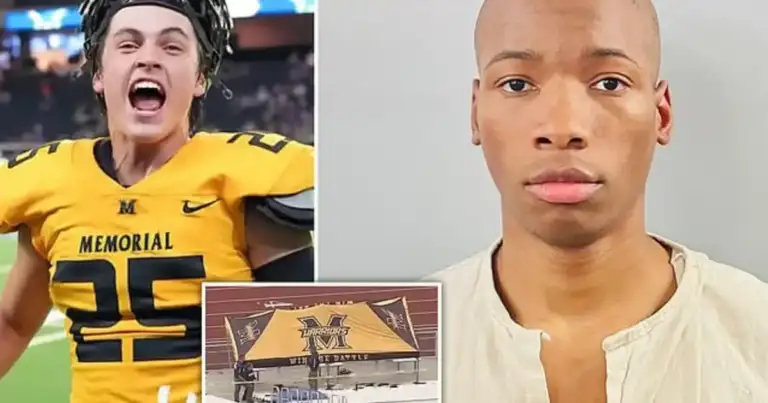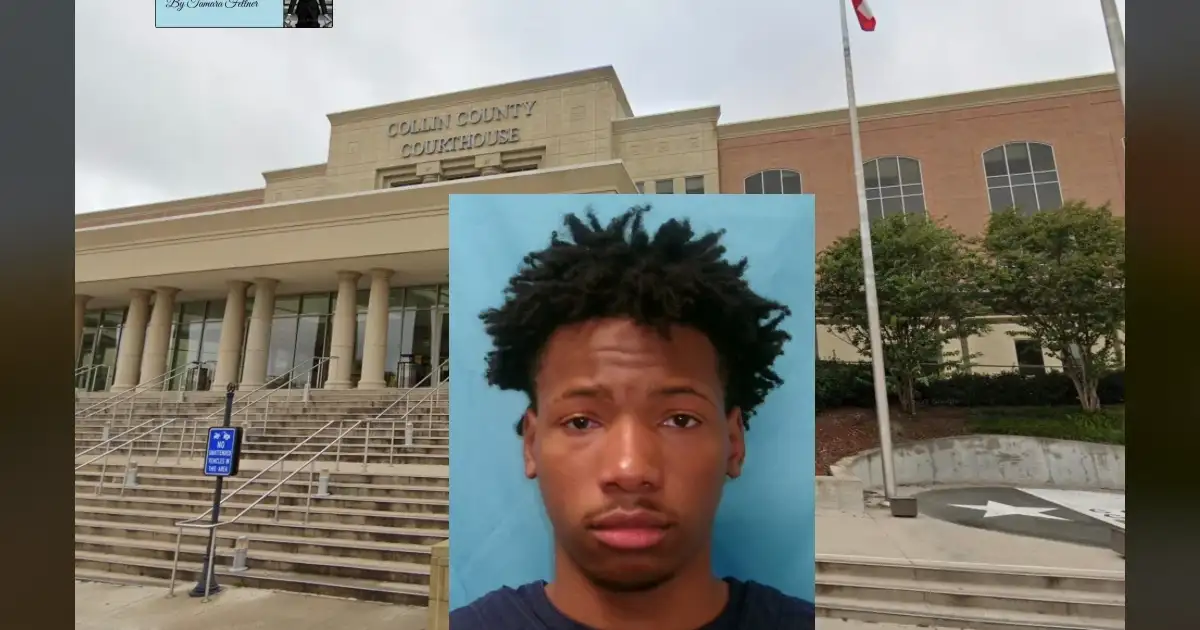

A father’s primal scream for justice ripped through a Texas courtroom, demanding more than just a verdict; he demanded a reckoning. David Metcalf, a man shattered by loss, stood before Karmelo Anthony, the murderer of his son, and forced the cold, hard truth of his grief into the public eye.
This was no ordinary sentencing hearing. It was a visceral, desperate plea that captivated a nation, laying bare the raw agony of victimhood against the stark backdrop of legal formality. Anthony, convicted of the first-degree murder of Austin Metcalf, received a 20-year prison sentence. The harrowing exchange, captured on video and reported widely, emerged on June 7, 2026, leaving an indelible mark on all who witnessed it.

The Confrontation That Shook a Courtroom
As the moment for his victim impact statement arrived, David Metcalf didn’t just speak from the podium; he walked directly to the defense table, his eyes locked on the man who had stolen his future. He recounted the devastation, the brutal void left by his son’s murder at a Texas track meet. His voice, thick with unimaginable pain, carved through the sterile courtroom air, a guttural cry from the soul.
“You took my son. You took our future. Look at me, you coward. Look at the man whose son you murdered.”
These words, broadcast by CNN, were not merely an expression of grief; they were an accusation, a challenge to the very humanity of the killer. Anthony, who had studiously avoided eye contact throughout the proceedings, faltered. For a fleeting, agonizing moment, he met Metcalf’s gaze before recoiling, his eyes darting away once more. Judge Elena Rodriguez, a figure of judicial stoicism, allowed the raw human drama to unfold for precious seconds before her duty compelled her to intervene. She acknowledged the immense suffering but firmly called for order.
“While the court understands the immense pain and grief, we must maintain order in these proceedings. Mr. Metcalf, please continue with your statement from the podium.”
This incident, preserved by courtroom cameras, echoes far beyond the confines of that room. It lays bare the profound gulf between legal process and human suffering, forcing us to confront what “justice” truly means for those left behind.
It was a moment of unvarnished truth: a father daring to demand an acknowledgment of his pain from its very source. In that demand, he spoke for countless others.
Anthony’s Appeal: A Legal Illusion?
The electrifying confrontation naturally provokes a pressing question: could David Metcalf’s potent words sway the outcome of Karmelo Anthony’s inevitable appeal? The answer, in the cold calculus of the law, is unequivocally clear: virtually none directly.
This intensely emotional exchange occurred during the sentencing phase, long after Anthony’s conviction. Appellate courts are not concerned with the theatricality of human emotion. Their focus is laser-sharp on identifying legal errors that may have occurred during the trial itself – procedural missteps, incorrect application of law, or constitutional violations.
For the defense to even attempt to leverage this moment, they would face an almost insurmountable hurdle. They would have to prove that Metcalf’s words created such extreme prejudice that it improperly influenced the judge’s sentencing decision.
This is a monumental task, especially given Judge Rodriguez’s immediate and clear call for order. Her swift intervention actually strengthens the legal record, demonstrating the court maintained control and prevented undue influence.
Therefore, while emotionally devastating, this scene is highly unlikely to alter Anthony’s legal fate. The wheels of justice, for better or worse, grind on with dispassionate precision when it comes to appeals.
Victim’s Rights vs. Courtroom Decorum: A Timeless Battle
This incident throws a spotlight on a perennial conflict: the deeply human need for victims to confront their perpetrators versus the rigid demands of courtroom decorum. Should victims be granted such direct, unscripted opportunities to face those who have wronged them? Many, including victims’ rights advocate Sarah Jenkins, argue with fierce conviction that they absolutely should.
“Mr. Metcalf’s courage reflects the profound need for victims to be seen and heard. It’s not about revenge; it’s about demanding that humanity be acknowledged in the face of unspeakable cruelty.”
Her statement on Fox News cuts to the core of the issue. For grieving families, the legal process is not merely an abstract sequence of procedures. It is a desperate, often last-ditch, attempt to reclaim a sliver of agency, to force the perpetrator to acknowledge the devastating reality of their actions. This is a fundamental human need, one that often clashes with the detached formality of the justice system.
Public sentiment overwhelmingly aligns with this view. A Reuters/Ipsos poll conducted in May 2026 revealed that a staggering 72% of Americans believe victims’ families should be allowed to confront offenders directly, even if it leads to emotional outbursts, provided it doesn’t fundamentally disrupt the legal process. The public, it seems, instinctively prioritizes the victim’s voice, understanding that the human cost of crime cannot be neatly contained within legal statutes.
Of course, some legal purists raise concerns about maintaining the sanctity and impartiality of judicial proceedings. They worry that such confrontations could cross a line, moving beyond emotional expression into intimidation or compromising the perceived fairness of the court.
But in this case, the confrontation occurred post-conviction, after guilt had been established. The notion that it could somehow undermine the fairness of a trial already concluded rings hollow.
The need for victims to speak their truth, to look their tormentor in the eye, often outweighs these abstract concerns.
The Elusive Search for Closure
Can a moment of raw confrontation, or even a 20-year prison sentence, truly deliver something as profound and often mythical as “closure”? For many, “closure” is a cruel illusion, a societal expectation that grief can simply be wrapped up and put away. Grief is not a temporary visitor; it is a lifelong companion, reshaped but rarely eradicated. A confrontation might offer a fleeting moment of reckoning, a sense of having asserted one’s will against an unimaginable wrong, but it seldom erases the searing pain.
Dr. Evelyn Reed, a distinguished professor of criminal psychology, offered her insights to NPR on the profound impact of these potent courtroom moments on all parties involved.
“For the victim’s family, it’s often a final, desperate attempt to elicit some form of acknowledgement or remorse. For the perpetrator, it can be a moment of forced reckoning, or simply a further entrenchment in their own denial.”
Her analysis underscores the complex psychological landscape of such encounters. A 2024 study by the National Center for Victims of Crime explored this further, revealing nuanced outcomes.
While over 85% of victims’ families who delivered victim impact statements reported feeling a greater sense of participation and, for some, a step towards closure, a significant 15% felt further traumatized or believed their statement had no real impact.
This data paints a stark picture: the path to healing is not linear, nor is it universally paved by confrontation. It remains a deeply personal, often solitary, journey.
Beyond the Verdict: Society’s Debt to Victims
This courtroom drama transcends the individual tragedy, highlighting a far broader societal question: what exactly does society owe the victims of violent crime? It is demonstrably more than just a legal verdict, more than a prison sentence, more than a fleeting moment of public sympathy. It is about recognizing their ongoing struggle, their shattered lives, and actively supporting their arduous healing journey.
Victim impact statements have evolved significantly since their widespread adoption in the 1980s, with the Supreme Court’s Payne v. Tennessee (1991) affirming their constitutionality and recognizing the victim’s fundamental right to be heard. But merely being heard is often insufficient. Society bears a profound responsibility to provide robust, sustained support systems that extend far beyond the courtroom’s final gavel. These are not luxuries; they are necessities.
Victims require more than just a moment to speak their truth. They need comprehensive counseling, tangible financial aid to rebuild lives often devastated by crime, and unwavering community support.
Their pain does not magically dissipate when the judge bangs the gavel; it continues for years, often a lifetime, a constant shadow.
David Metcalf’s raw, defiant demand for eye contact was a powerful, unforgettable act—a father’s visceral refusal to let his son’s death be reduced to mere legal paperwork. It was a stark, humanizing reminder of the true, incalculable cost of crime, and a challenge to us all to ensure justice is not just legally sound, but profoundly, enduringly human.
Source: Google News