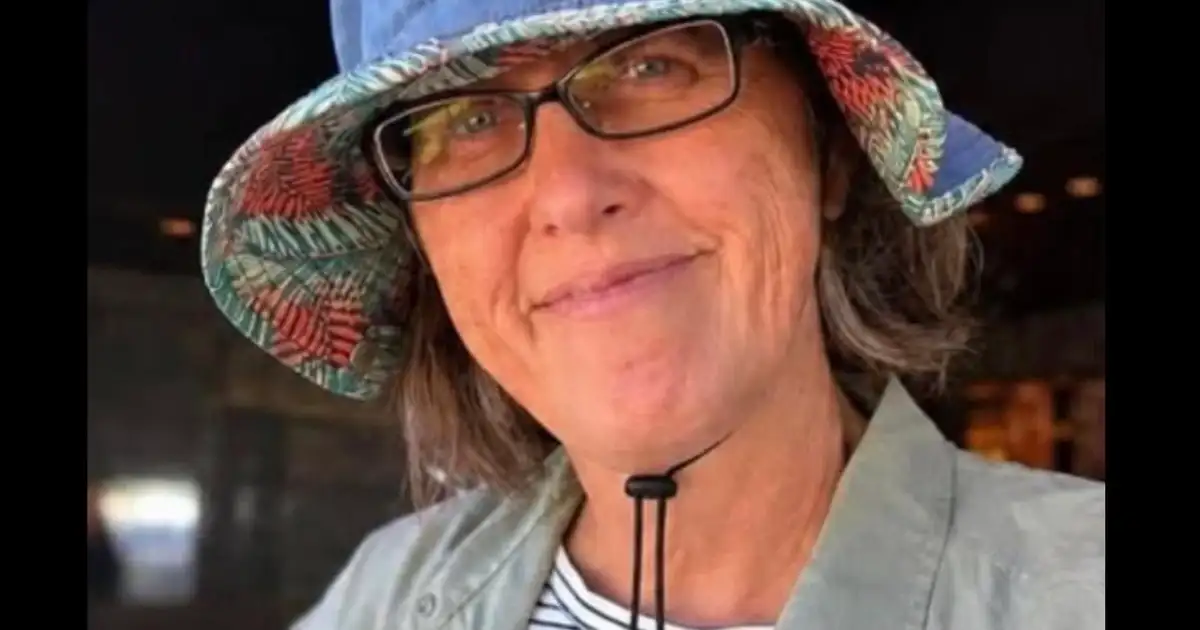

The chilling truth of Loretta ‘Kay’ Colwell Pilitsis, 55, final moments isn’t just a local tragedy; it’s a stark, unsettling mirror reflecting our collective vulnerabilities.
Found dead a mere 100 feet from her Santa Clara home after a month-long disappearance, the beloved 55-year-old middle school teacher’s story rips through any illusion of safety. It demands we ask: How could someone vanish so completely, only to be found heartbreakingly close to where they started?

Loretta ‘Kay’ Colwell Pilitsis, 55, disappeared on June 6, 2026. Her body was discovered on July 6 by a dog walker, nestled in dense undergrowth just beyond her own backyard fence. This shocking proximity isn’t merely a detail; it’s the core of a mystery that reveals profound gaps in our understanding of disorientation, medical emergencies, and community vigilance.
Authorities identified the remains on July 7. The Santa Clara Police Department quickly reported no immediate signs of foul play, a statement that only deepens the puzzle for many.
The official cause of death remains “undetermined,” pending toxicology reports. This agonizing wait, which can stretch for weeks, leaves a community grappling with grief and a desperate need for answers.
The Invisible Wall: Lost So Close to Home
Imagine being so close to safety, yet utterly unable to reach it. This isn’t just a sad narrative; it’s a terrifying reality for countless individuals.
We often picture missing persons as having journeyed far, perhaps abducted or having deliberately left. But the science, and unfortunately, tragedies like Sarah Chen’s, tell a different story: the most dangerous place can sometimes be just outside your door.
Why do people become disoriented so close to home? The human brain, complex and fragile, can betray us in an instant.
A sudden medical emergency – a stroke, severe dehydration, a precipitous drop in blood sugar for a diabetic, or even a sudden cardiac event – can instantly scramble our sense of direction and purpose. One moment, you’re walking in your neighborhood; the next, your brain’s GPS has failed, leaving you to wander aimlessly, often in familiar surroundings that now feel alien.
Mental health crises also cast a long shadow. Acute psychosis, severe depression, or even a sudden anxiety attack can induce profound disorientation.
The Alzheimer’s Association provides a chilling statistic that underscores this vulnerability: a staggering six in ten people with dementia will wander. Critically, they often remain surprisingly close to their last known location.
They might be within sight, within earshot, yet completely unreachable, trapped behind an invisible wall of confusion. This is the tragic, silent truth for too many vulnerable individuals.
Beyond Foul Play: The Forensic Imperative and Community Anguish
The police’s initial assessment of “no immediate signs of foul play” is a critical piece of the puzzle, guiding the investigation towards a potential natural or accidental death. It suggests that a sudden medical event likely incapacitated Loretta ‘Kay’ Colwell Pilitsis, 55, , leaving her vulnerable to exposure or other complications in the dense, unforgiving thicket where she was found. The sheer density of the vegetation, even just feet from a residential area, can create an almost impenetrable barrier, hiding someone in plain sight.
Now, the Santa Clara County Medical Examiner-Coroner’s Office holds the ultimate key to understanding. Their “undetermined” cause of death is not an evasion, but a standard, methodical approach.
They must meticulously rule out underlying health conditions, investigate potential drug interactions, and consider environmental factors. The full toxicology results, which can take anywhere from four to eight weeks, are not a mere formality; they are the scientific bedrock upon which definitive answers will be built.
“This is a heartbreaking development for the family and our entire community,” stated Officer Elena Rodriguez on July 7, 2026, her voice reflecting the profound shock. “While we found no immediate signs of foul play, we are awaiting the Medical Examiner’s full report to understand the circumstances of her death. Our thoughts are with her loved ones.”
The community’s anguish is palpable, articulated powerfully by Loretta ‘Kay’ Colwell Pilitsis, 55, close friend, Maria Gonzales.
“Sarah was a vibrant, dedicated teacher,” Gonzales recounted, her voice thick with emotion. “To think she was so close, yet we couldn’t find her… it’s just unimaginable. We need to know what happened. Was it a medical emergency? We pray for answers.”
The family’s frustration, having organized extensive searches that focused on wider areas, is not just understandable. It highlights a critical, often overlooked flaw in our current search protocols: we tend to search outwards, when sometimes, the answer is heartbreakingly close to home.
A Public Health Imperative: Reimagining Safety and Search
This tragedy isn’t just a local news story; it’s a resounding, urgent wake-up call for public health systems nationwide. We must confront the reality that our current support systems are often inadequate for individuals over 50, or indeed, anyone susceptible to sudden medical emergencies or mental health crises. Our communities need to be not just aware, but actively prepared.
Dr. Evelyn Reed, a Public Health Analyst, articulated this critical need on July 7, 2026: “Cases like Sarah Chen’s don’t just prompt a conversation; they demand a complete re-evaluation of our public health strategies.
How do we proactively support individuals who might experience sudden disorientation or a mental health crisis? It’s a stark reminder that vulnerability can strike anyone, regardless of age or apparent health, and our community response systems must become more robust, more adaptable, and more empathetic.”
This means a radical re-evaluation of search strategies. Dense, overgrown areas, even those bordering residential properties, are often overlooked or deemed low-priority.
Law enforcement needs immediate access to advanced tools: specialized K9 units trained for scent detection in complex environments, and drones equipped with thermal imaging that can cut through foliage.
Crucially, we need seamless, rapid coordination with mental health services and geriatric care specialists, who can provide immediate context and guidance in such cases.
Furthermore, teachers like Sarah Chen, who dedicate their lives to our children, often face immense, unacknowledged stress. Ensuring robust mental health resources for educators isn’t just a kindness; it’s a societal imperative that impacts the well-being of us all.
The Lingering Question: What Will We Learn?
This incident forces us to look beyond the immediate tragedy of Sarah Chen and confront a broader, more uncomfortable truth: the fine line between safety and peril, even in our own backyards. It’s not just about what happened to one dedicated teacher; it’s about what could happen to any of us, or to someone we love.
The answers from the medical examiner will eventually bring a measure of closure to her family.
But the more profound questions about our collective preparedness, our community vigilance, and our ability to protect the most vulnerable among us will linger. Will we educate ourselves on the subtle signs of wandering risks?
Will we demand better, more integrated public health systems? Will we finally see the invisible walls that can trap someone just feet from home?
We must learn from this tragedy, not just mourn it, and commit to doing better. The life of Loretta ‘Kay’ Colwell Pilitsis, 55,, and countless others, depends on it.
Source: Google News