
Honey, let’s talk about a trainwreck. Not just any trainwreck, but a high-octane, globally televised, multi-million dollar disaster that left billions scratching their heads.
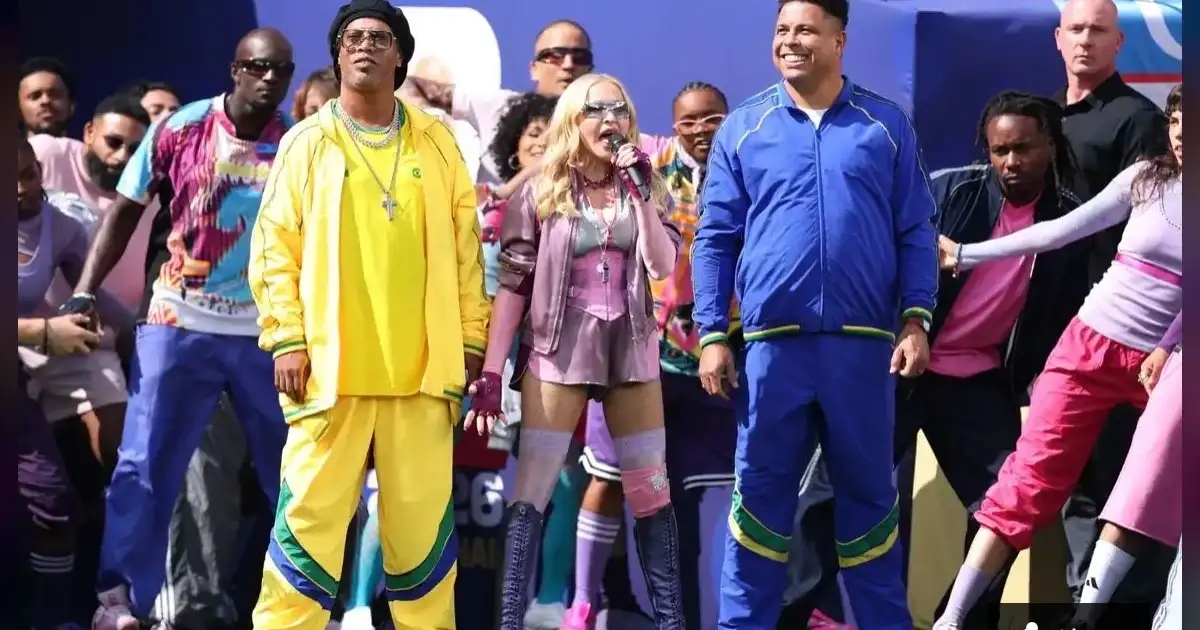
FIFA’s much-hyped, first-ever World Cup halftime show was a certified, unmitigated disaster. Pop titans Madonna and Justin Bieber delivered a spectacle so bizarre it united fans across the globe in sheer bewilderment.

This grand experiment, meant to rival the legendary Super Bowl, didn’t just crash and burn – it imploded harder than a supernova in a glitter factory. It all went down on Sunday, July 18, 2026, during the nail-biting Brazil vs. France semi-final match.
That 15-minute performance wasn’t just confusing; it was a cultural moment of collective “WTF?” that sent social media into an immediate, furious uproar.
FIFA’s Hollywood Dream Becomes a Nightmare
The show itself was a fever dream of questionable choices. Madonna, the Queen of Pop, emerged in a series of truly wild, avant-garde outfits.
One particular ensemble, a futuristic football helmet adorned with LED lights, looked less like a fashion statement and more like a prop from a forgotten sci-fi movie.
Then there was Justin Bieber, who inexplicably brought out a rumored hologram of a famous deceased pop star. This move didn’t just spark confusion; it ignited a firestorm of “too soon?” and “what is happening?!”
The sound? Oh, the sound! It was an absolute mess, with muffled, often unintelligible vocals battling overwhelming backing tracks. It was impossible to discern if anyone was actually singing live. Was this a concert or a tech demo gone horribly wrong?
The internet, as you can imagine, had zero chill. Hashtags like #FIFAHalftimeFail and #WorldCupDisaster didn’t just trend; they dominated conversations worldwide.
Fans didn’t just question the artistic direction; they openly mocked it, demanding to know how such a colossal amount of cash could produce such a chaotic mess. Industry insiders are whispering that the production budget easily soared past $25 million. Imagine that! Twenty-five million dollars for that.
This wasn’t just a random performance; it was FIFA’s first dedicated halftime show of this magnitude. It was a blatant, almost desperate, attempt to mimic the NFL’s Super Bowl success.
The strategy was clear: lure younger viewers, tap into new audiences, and boost engagement in lucrative entertainment markets, particularly North America.
Let’s be real, behind all the talk of “global entertainment festival,” it was always about the money. FIFA was eyeing fatter sponsorship deals and juicier broadcasting rights, planning this expanded entertainment format for years.
They wanted a slice of that sweet, sweet Super Bowl pie, but what they got was a pie to the face.
The Fallout for Pop Royalty and a Global Game
The backlash, my dears, has been relentless, continuing for a full 48 hours straight and showing no signs of slowing down.
FIFA, usually so quick to defend its decisions, has remained conspicuously silent. Madonna’s and Bieber’s reps have also gone radio silent, leaving us all to wonder what exactly went on behind the scenes.
Sources close to the production are whispering about epic creative disagreements, technical meltdowns, and a general sense of panic.
Broadcasters, meanwhile, are reportedly seeing a significant drop-off in viewership during the halftime segment – a commercial nightmare for anyone who bought ad space.
The public reaction wasn’t just brutal; it was laced with a sense of betrayal. Fans felt the show actively disrespected the World Cup’s rich tradition, turning a revered sporting event into a garish spectacle.
The hologram, Madonna’s abstract costumes – they weren’t just alienating, they felt like a slap in the face to the “beautiful game.” This wasn’t football; it was a bizarre, over-the-top circus that nobody asked for.
“What just happened? Was that supposed to be art or a fever dream? I just wanted to watch football.”
– @FootballFanatic78, X (formerly Twitter)
Even football legends, usually reserved, couldn’t hold back. Gary Lineker, never one to mince words, slammed it hard.
“FIFA tried to go Hollywood and ended up in a B-movie. Stick to the beautiful game.”
– Gary Lineker, former footballer and BBC pundit (quoted by The Guardian)
Model and cultural commentator Emily Ratajkowski, known for her sharp observations, didn’t pull any punches either.
“The sound was atrocious, the visuals were baffling. It felt like a dress rehearsal that went horribly wrong on the biggest stage.”
– Emily Ratajkowski (from an Instagram story, widely reported)
Who’s Really Picking Up the Pieces?
FIFA aimed for innovation, bless their hearts, but what they got was a collective, global eye-roll. Their meticulously crafted reputation for delivering world-class events has taken a serious, undeniable hit.
Future sponsorship deals? They’ll likely be a much tougher sell now. This wasn’t just a miscalculation; it was a catastrophic blunder that will haunt them for years.
For Madonna and Bieber, this was meant to be a massive, career-defining platform. Instead, the attention they garnered was overwhelmingly negative. Was it a bold artistic statement, or simply a colossal misstep that will forever be a cringe-worthy footnote in their otherwise illustrious careers? Their carefully cultivated brands could undoubtedly suffer from being inextricably tied to such a universally panned event.
And let’s not forget the sponsors who poured millions into the World Cup. Now, their investments are overshadowed by a torrent of negative buzz.
They’re not just feeling short-changed; they’re likely fuming.
This entire debacle raises profound questions about the relentless commercialization of sports. When does “boosting engagement” cross the line into outright disrespect?
The World Cup tried desperately to be something it’s not. It tried to force a distinctly American entertainment culture onto a global football stage, and the result was a loud, expensive, and utterly despised mess.
Perhaps, just perhaps, some traditions are best left untouched, cherished for their authenticity rather than sacrificed on the altar of commercial ambition.
What do you think? Did FIFA learn its lesson, or are we doomed to more halftime horrors?
Source: Google News