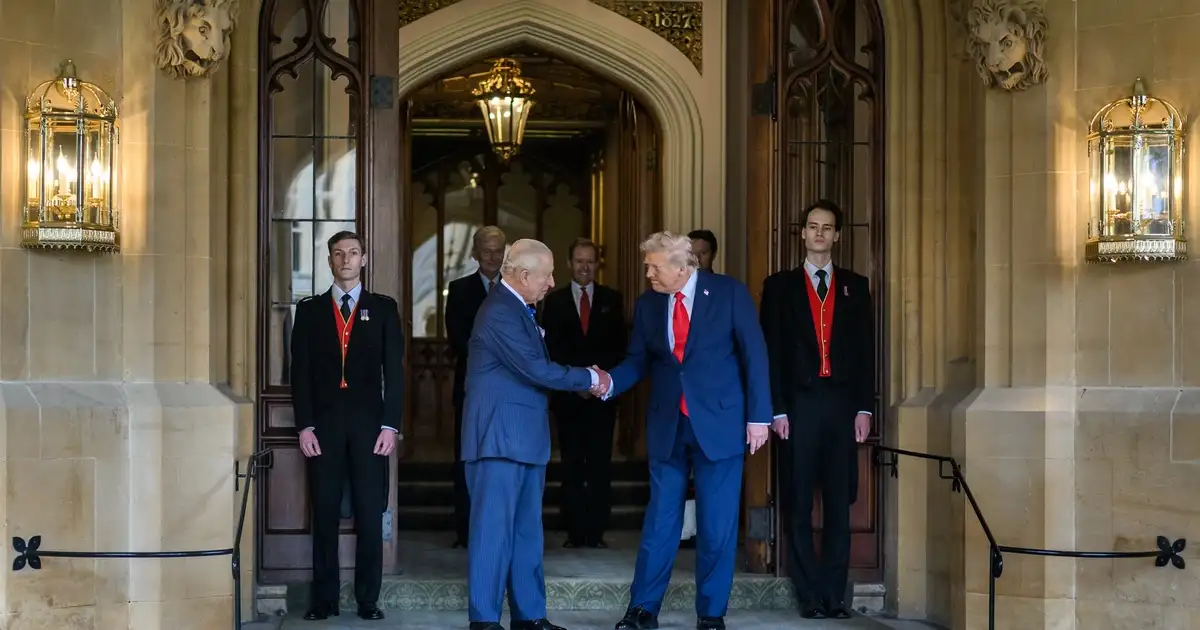

President Donald Trump’s “subtle but friendly move” with King Charles III immediately shattered royal protocol. This isn’t just a breach; it’s a glaring spotlight on the monarchy’s outdated performative theatrics.
Reports confirm that during a recent visit, President Trump engaged in an informal gesture with King Charles. Sources suggest it was a “back-pat” or “soldier chit-chat,” an attempt at personal warmth. Yet, this simple act deviated sharply from established royal customs.

The exact details are scarce, but the outcome is clear. Trump’s approach bypassed the rigid diplomatic etiquette the British Royal Family usually demands. This informal style is consistent with his past interactions, often characterized by a less deferential stance.
The Manufactured Outrage Machine
The public reaction online has been brutal, not for Trump, but for the royal establishment. Social media is roasting the monarchy for its “pearl-clutching” over a trivial interaction. It’s a classic case of manufactured drama.
Users on Reddit and X (formerly Twitter) tore into the perceived outrage. One viral comment mocked, “Charles snaps ‘We don’t normally talk to them’ like a dowager aunt at a funeral—Trump’s just being human, you fossils.” This isn’t about respect; it’s about control.
Online commentators savaged the King’s alleged “lip-read snub” as “impatient autism” or “boomer entitlement.” Memes featuring Charles as a grumpy corgi herder flooded feeds. The spectacle became less about protocol and more about the monarchy’s public image problem.
A Cynical Read on Royal Stiffness
This isn’t an isolated incident. President Trump has a history of unconventional interactions with royalty. Remember Melania Trump’s non-curtsey during a previous visit? These moments are not accidental; they are strategic or, at the very least, revealing.
The online discourse calls this entire episode “peak tabloid theater.” Conspiracy corners on 4chan and TikTok suggest it was a “staged psyop.” They argue Trump’s “friendly” pat was deliberate bait to troll protocol purists. It boosts his alpha image while King Charles plays the victim.
“Subtle move? It’s WWE heel work—Charles ‘interrupts’ for the viral clip,” one thread sneered. This perspective views the interaction as a calculated performance. It highlights the transactional nature of high-level diplomacy.
Why would Trump deliberately break protocol? Simple: to make a point. He challenges norms. He disrupts expectations. For a global figure like President Trump, a “breach” of royal etiquette isn’t a gaffe; it’s a power move. It shows who sets the terms of engagement.
The Real Protests and the Monarchy’s Bluster
While the online world debated a “pat,” real protests unfolded outside Windsor. Thousands branded the visit itself “humiliating,” not because of Trump’s gesture, but for the UK’s decision to host him. They called him a “convicted felon,” questioning the monarchy’s judgment.
British citizens fumed, asking, “Why host this clown if protocol’s so sacred? Charles looks like a kicked spaniel.” This cuts to the heart of the matter. The monarchy’s insistence on rigid protocol seems absurd when weighed against the controversy of the guest.
It exposes a glaring hypocrisy. The Crown can ignore public sentiment about hosting a controversial figure. Yet, it gets its knickers in a twist over a simple gesture of familiarity. This selective outrage makes the institution look weak and out of touch.
The monarchy thrives on maintaining an air of untouchable tradition and formality. When someone like President Trump treats them like a regular person, their carefully constructed facade cracks. It reveals the vulnerability beneath the pomp and circumstance.
What This “Breach” Actually Reveals
This incident isn’t about a handshake or a pat on the back. It’s about perception. It’s about the erosion of deference. It’s about a world that no longer bows unquestioningly to archaic traditions.
President Trump’s casual approach, whether intentional or not, forces the monarchy to confront its own rigidity. It highlights the absurdity of clinging to centuries-old customs in a hyper-connected, informal world. The Crown struggles to adapt, and it shows.
The “protocol debate” is a smokescreen. The real story is the monarchy’s desperate attempt to control its narrative. They want to project an image of dignified continuity. But Trump’s actions, and the public’s reaction, expose the cracks in that image.
It’s an age-old power struggle. The old guard versus the new. Tradition versus disruption. In this battle, the monarchy’s adherence to “protocol” feels less like strength and more like a sign of weakness. It’s a sign they are losing control of the conversation.
The British public, often portrayed as reverent, is clearly over it. They see the charade. They understand that a “subtle move” means nothing compared to the larger political implications. Their cynicism is a direct challenge to royal authority.
The Monarchy’s Losing Battle
The world is changing. Global leaders like President Trump operate on a different wavelength. They prioritize directness over decorum. They value personal connection, even if it means bending or breaking established rules.
The monarchy’s response, or the perceived response, to this “breach” only amplifies the problem. It makes them seem petty and out of touch. It paints them as guardians of an irrelevant past.
This entire episode serves as a powerful reminder. The rules of engagement are no longer dictated solely by ancient institutions. Modern leaders, for better or worse, are rewriting the playbook. And the monarchy is struggling to keep up.
So, was it a “subtle but friendly move” or a deliberate provocation? Perhaps both. What’s undeniable is the reaction. The British monarchy, once thought unshakeable, now appears fragile. Its protocols are exposed as flimsy defenses against a changing world. They are less about respect and more about maintaining an illusion.
Source: Google News