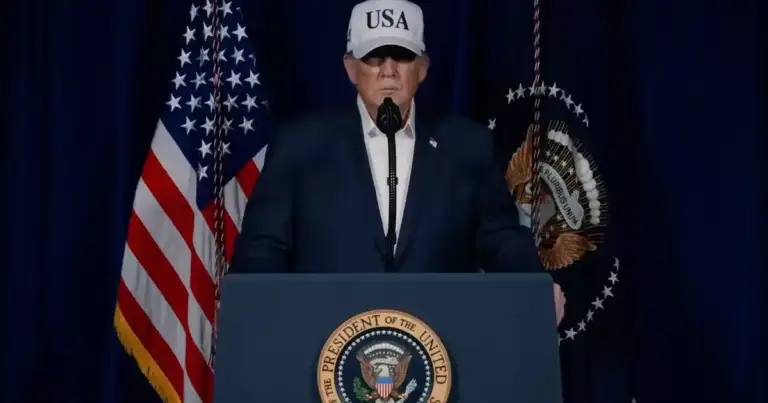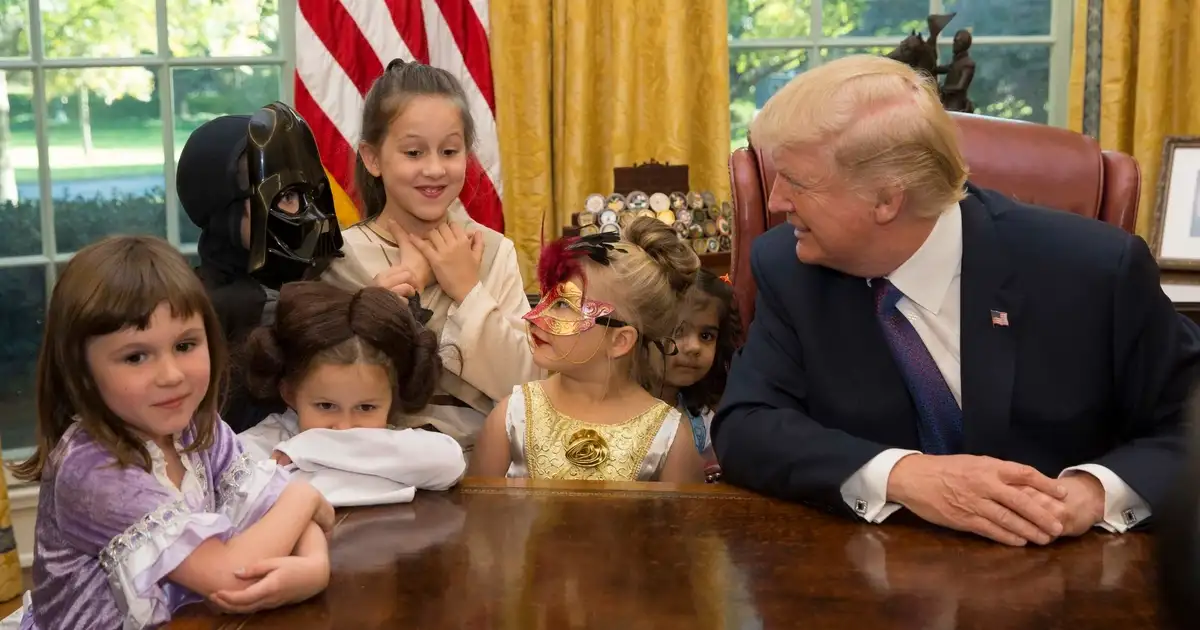

Forget the intricate dance of economic policy; President Donald Trump just orchestrated a political spectacle for the ages, ringing Wall Street’s opening bell from the hallowed halls of the White House to declare a fantastical $7,500 windfall for 1.4 million American babies. This wasn’t merely news; it was pure D.C. theater, a meticulously crafted illusion designed to convince you that the economic boom isn’t just roaring, it’s landing directly in your newborn’s crib.
On Monday, July 6, 2026, the East Room of the White House, typically reserved for state dinners and solemn declarations, was transformed into a bizarre simulacrum of the New York Stock Exchange. President Trump presided over a symbolic “opening bell” ceremony – a ritual usually confined to the trading floor, not the people’s house. The message was clear, if audacious: his presidency, he implied, was the ultimate market driver, and its dividends were supposedly trickling down to the most innocent among us.

Trump didn’t just announce a benefit; he proclaimed a monumental economic miracle: a $7,500 “windfall” for each of the 1.4 million babies born in the last fiscal year. This staggering $10.5 billion impact, he asserted, was a direct consequence of his administration’s policies and his unwavering economic vision. It was a claim so grand, so specific, and yet so ethereal, it immediately raised eyebrows across the political spectrum.
The Bell Rings for Whom?
The centerpiece of this theatrical display was a specially commissioned brass bell, which President Trump himself rang with characteristic flourish. Standing conspicuously beside him was a representative from a major financial institution – a deliberate visual cue, designed to forge an unbreakable, if imagined, link between Wall Street’s soaring performance and the prosperity of everyday American families. The symbolism was heavy-handed, yet undeniably effective for its intended audience.
Trump’s supposed rationale for this “windfall” rested on a familiar trifecta: “robust economic growth,” “strategic tax incentives,” and the tantalizing promise of a new “Family Prosperity Fund.” Yet, like so many grand pronouncements from this White House, the devil was, as always, in the details – or rather, their glaring absence.
No concrete legislative framework, no sustainable funding mechanisms, and no clear path to implementation were offered. It was a vision built on air, designed to captivate rather than clarify.
Indeed, the market has recently enjoyed a period of significant uplift, with the Dow Jones Industrial Average rising 3.2% last quarter and the S&P 500 climbing 4.1% in the same period. These figures certainly fuel the narrative of economic strength – a narrative Trump is desperate to own. But here’s the uncomfortable truth: does a rising tide truly lift all boats equally, particularly when those “boats” are, metaphorically speaking, still in their cribs, utterly dependent on the tides reaching their shores?
The Real Cost of a “Windfall”
Let’s cut through the rhetoric: a “windfall” of $7,500 per child sounds undeniably appealing, a benevolent gift from the heavens. But for the vast majority of American families, this isn’t a tangible check destined for their mailbox.
It’s a theoretical construct, a phantom benefit contingent on volatile market performance and access to investment opportunities that remain utterly out of reach for many. New parents, grappling with the relentless realities of diapers, formula, and sleepless nights, are focused on immediate needs, not the abstract gyrations of stock portfolios.
Democrats, predictably, wasted no time branding the entire affair a cynical political stunt. They immediately questioned the dubious methodology, challenging how any direct causation between Trump’s policies and a specific, per-child “windfall” could possibly be proven.
Critics pointed out, with ample justification, that whatever economic benefits have accrued largely concentrate among the already wealthy, while persistent child poverty rates continue to plague the nation. Their counter-argument was clear: direct, universal support programs, not market-dependent fantasies, are what struggling families truly need.
Even independent economists, while acknowledging recent market strength, greeted the President’s pronouncement with profound skepticism. The notion of a direct $7,500 windfall per baby, they argued, defies economic logic.
Market gains are inherently volatile, never guaranteed, and the impact of tax incentives varies wildly depending on individual family income and structure. The proposed “Family Prosperity Fund,” they insisted, remains an empty vessel, requiring not just “real money” but a concrete, transparent plan for its funding and distribution – elements conspicuously absent from the White House briefing.
Political Playbook for 2028
Make no mistake: this event transcended babies and economics. It was a meticulously choreographed political maneuver, a blatant opening salvo in what is widely anticipated to be President Trump’s bid for the 2028 presidential election.
This White House spectacle, staged with all the pomp and circumstance of an official address, served as a campaign rally in all but its formal designation. It was a preview of the rhetorical battles to come.
Connecting abstract economic “wins” directly to the kitchen tables of American families is a classic, cynical political maneuver. It’s about crafting a compelling narrative, one that asserts his vision delivers not just prosperity, but personal prosperity.
The carefully curated optics of President Trump, bell in hand, flanked by Wall Street titans, sent an unmistakable message. His leadership, and his alone, makes the market soar, and this market surge, he wants you to believe, directly translates into a fatter wallet for your newborn. It’s a powerful, if misleading, piece of political theater.
Yet, back in the harsh light of everyday reality, the average American family isn’t witnessing $7,500 magically materialize in their bank accounts. They are still grappling with stubbornly rising costs, burdened by crushing student loan debt, and struggling to save for their children’s increasingly expensive futures. For these families, the grand promise of a market-driven windfall, utterly devoid of concrete action or a clear delivery mechanism, doesn’t just ring hollow – it echoes with a cruel irony.
The Unseen Hand of Power
So, who genuinely profits from this elaborate charade? Wall Street, undoubtedly, receives a significant public relations boost and a presidential endorsement that signals continued favorable policies.
Wealthy investors, those with the capital to actively participate in the stock market, certainly benefit from its gains. For them, a rising market translates directly into more money, more assets, and greater influence. Their “windfall” is real, tangible, and immediate.
But what about the everyday taxpayer, the very families this “windfall” purports to benefit? The proposed “Family Prosperity Fund,” a mere placeholder in this announcement, will eventually demand real funding.
And from where, precisely, will that money materialize? It’s a promise that, if ever fulfilled, will inevitably be paid for by all of us, through taxes or increased national debt.
In the interim, any direct benefits for the vast majority of families remain purely theoretical, tethered precariously to the whims of market fluctuations, rather than grounded in guaranteed support.
This, then, is the cynical, unvarnished truth of Washington’s political theater. Power players, adept at manipulating public perception, routinely deploy grand gestures and make sweeping claims that play beautifully on cable
Source: Google News