
Madison Square Garden became a hostile stadium for former President Donald Trump on Sunday, June 7, 2026. What should have been a routine national anthem quickly devolved into a merciless torrent of boos for Trump and his granddaughter, Kai. The Celtics routed the Knicks 108-99, but the game’s outcome was secondary to the political spectacle.
This wasn’t just fan noise; it was a thunderous, tactical warning shot fired across the bow of his 2028 presidential campaign. It signaled the brutal political gauntlet he faces, especially in deep-blue strongholds like New York.

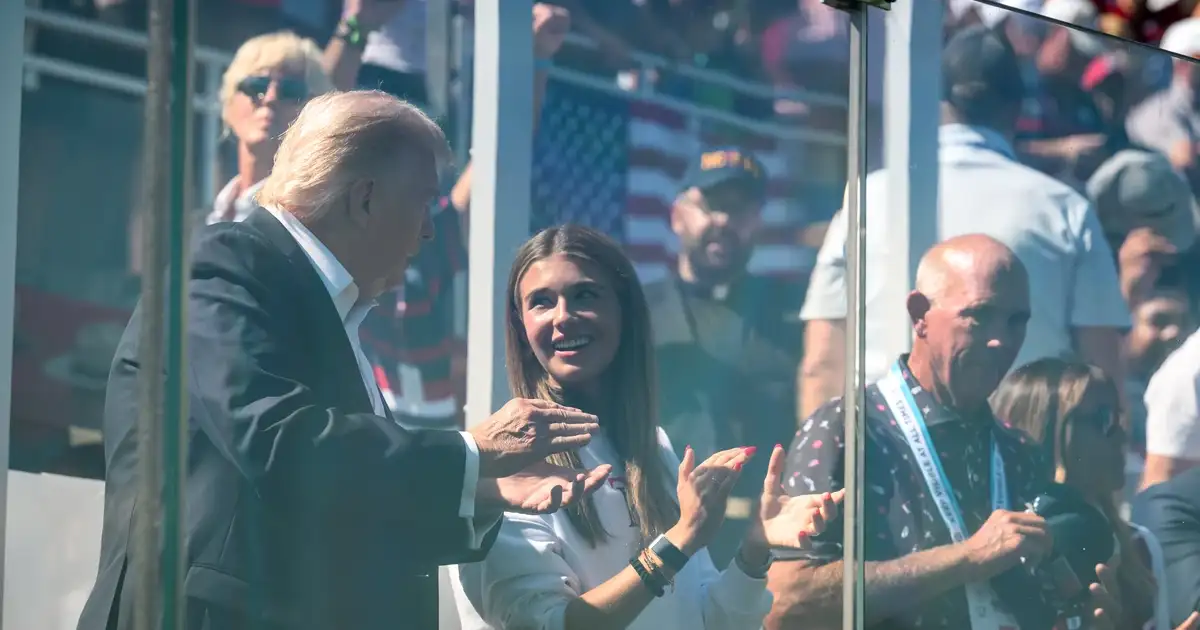
As the anthem played, the storm of boos rained down on Trump. He stood stoic, a veteran quarterback weathering a blitz, his gaze fixed forward. His granddaughter, Kai Trump, offered a knowing smirk, completely unfazed by the hostile crowd.
This was a subtle but potent signal that this new generation understands the game is played differently now. The optics were unavoidable, sparking immediate, intense debate across every media channel and social platform. This wasn’t merely a basketball game; it was a stark, undeniable political statement, played out on one of the grandest stages in America.
The Blue State Blitz: New York’s Impenetrable Defense
New York has never been an easy opponent for Trump; it’s an electoral fortress, a solid Democratic stronghold that has consistently voted blue. In 2020, Joe Biden didn’t just win the state; he delivered a crushing blow, securing over 60% of the vote. That, folks, is a blowout, a clear indication of the state’s political leanings. For any Republican, let alone Trump, cracking this defensive line is a monumental task.
The city, especially, operates on an entirely different gridiron. Urban centers like New York City aren’t just Democratic; they are overwhelmingly, unapologetically hostile territory for the former President. A reception like the one at MSG isn’t just predictable; it’s as guaranteed as a defensive holding call against a struggling offense.
Trump knows this playbook intimately. He understands the terrain, yet he chose to step onto this particular field.
This isn’t Trump’s first rodeo facing a barrage of jeers at a sporting event. He faced similar, though perhaps less intense, boos at the 2019 World Series in Washington D.C. UFC events have also seen him draw a mixed, often vocal crowd.
But MSG, in the heart of New York City, carries a different weight. These aren’t just consistent signals from the public; they are escalating declarations of a deep-seated opposition that refuses to be silenced, even during a national anthem.
Reading the Field: Trump’s Calculated Stoicism vs. Kai’s Defiant Smirk
Trump’s stoic demeanor at MSG was no accident; it was a calculated move, a veteran player’s response to an anticipated onslaught. He’s a seasoned combatant in the public arena, a master at projecting strength and defiance under fire. For years, he has faced relentless opposition, and his unyielding posture is designed to communicate resilience, to tell his base that he remains unbowed, even in the face of such overwhelming hostility.
But the real tell, the more intriguing signal from the sidelines, was Kai Trump’s smirk. That wasn’t just youthful defiance; it was a snapshot of a new generation, one that has grown up immersed in this hyper-polarized world. They are not merely observers; they are active participants, ready to engage with, or dismiss, political figures with an entirely different attitude.
This generation isn’t playing by the old rules of decorum or reverence for office. They view the political landscape through a lens sharpened by constant digital interaction and a profound distrust of traditional authority. Kai’s smirk wasn’t apathy; it was a quiet, confident assertion of a new, more confrontational political engagement.
This incident offers more than just a glimpse; it’s a stark revelation into how young people process these deep, societal divisions. It signals a generational shift in how public figures are perceived and challenged. This isn’t merely a new dynamic; it’s a fundamental reshaping of how political battles will be fought and won, where personal branding and digital defiance might eclipse traditional campaign rhetoric.
The 2028 Playbook: Beyond the Core Base
Trump’s appearance at MSG was more than a public outing; it was an involuntary litmus test, a high-profile event that laid bare the depth of public sentiment. The sustained booing reinforces the image of a deeply fractured, relentlessly divided electorate. It starkly illustrates the monumental challenges Trump faces in expanding his appeal beyond his fervent core base—a base that, while loyal, is often geographically concentrated and insufficient for national victory.
Winning a national election isn’t just about energizing your base; it requires converting, or at least neutralizing, some of those booing fans. It means reaching beyond the echo chambers and persuading voters in critical swing states and demographics that remain deeply skeptical. This incident, played out in a major media market like New York City, doesn’t just amplify a narrative of strong opposition; it actively contributes to a perception of unelectability in broader swaths of the country, a perception that can be devastating for any presidential contender.
As 2028 presidential contenders, both Republican and Democratic, start mapping out their strategies, this kind of visceral public reaction is invaluable, albeit uncomfortable, data. It pinpoints precisely where the opposition is strongest, highlighting the immense effort and strategic ingenuity needed to sway voters in critical, often hostile, areas. The path to the White House in 2028 will demand an offensive strategy capable of penetrating these entrenched blue state defenses.
“President Trump is a fighter, and he is used to the biased attacks from the liberal media and their allies. He enjoyed the game and the support he received from true American patriots,” said Steven Cheung, Trump’s campaign spokesperson, to Fox News.
That’s the predictable spin from the campaign, designed to frame the boos as partisan attacks rather than genuine public sentiment. But the reality on the ground, inside the Garden, was profoundly different. The noise was not just deafening; it was an undeniable, unfiltered expression of widespread disapproval, a cacophony that no amount of spin can truly obscure.
The Anthem: A Political Battleground
The national anthem, once a sacred moment of unity and reflection, has tragically transformed into a volatile backdrop for protest and political commentary. This shift didn’t begin at MSG; it has been evolving since Colin Kaepernick’s protests, steadily blurring the lines between sports and politics. What was once a respite from the daily grind has become an extension of it, a new arena where ideological battles are waged.
Sports fans are now deeply split. Some desperately cling to the ideal of keeping politics out of the game, yearning for a pure escape. Others, however, view the stadium as a legitimate, even necessary, place to voice dissent, a public forum where silence might be interpreted as complicity.
This incident at MSG shows that line is not just blurrier than ever; it has effectively vanished. It’s virtually impossible to escape the pervasive, all-encompassing nature of our current political climate, even when the ball is tipped.
“It’s Madison Square Garden, not a rally. But honestly, if he’s going to show up, he has to expect a reaction. It’s New York,” Sarah Jenkins, a Knicks fan, told CNN.
She nailed it. You step into the arena, you face the crowd. You enter the public square, you face the public’s judgment. This isn’t just about basketball anymore; it’s about the pervasive, inescapable nature of political polarization that has seeped into every facet of American life. The days of politicians attending sporting events without consequence are long gone, replaced by a new era where every public appearance is a potential flashpoint.
The cacophony at MSG wasn’t merely background noise; it was a tactical reminder, a stadium-sized roar confirming the deep fault lines scarring American society. It underscored the monumental electoral challenges Trump faces in blue territories—a defensive scheme he has yet to crack. The 2028 election isn’t just on the horizon; it’s already a brutal, full-contact contest, and this Game 4 spectacle was far more than an opening whistle. It was a thunderous, unmistakable declaration of war on the political gridiron.
Source: Google News