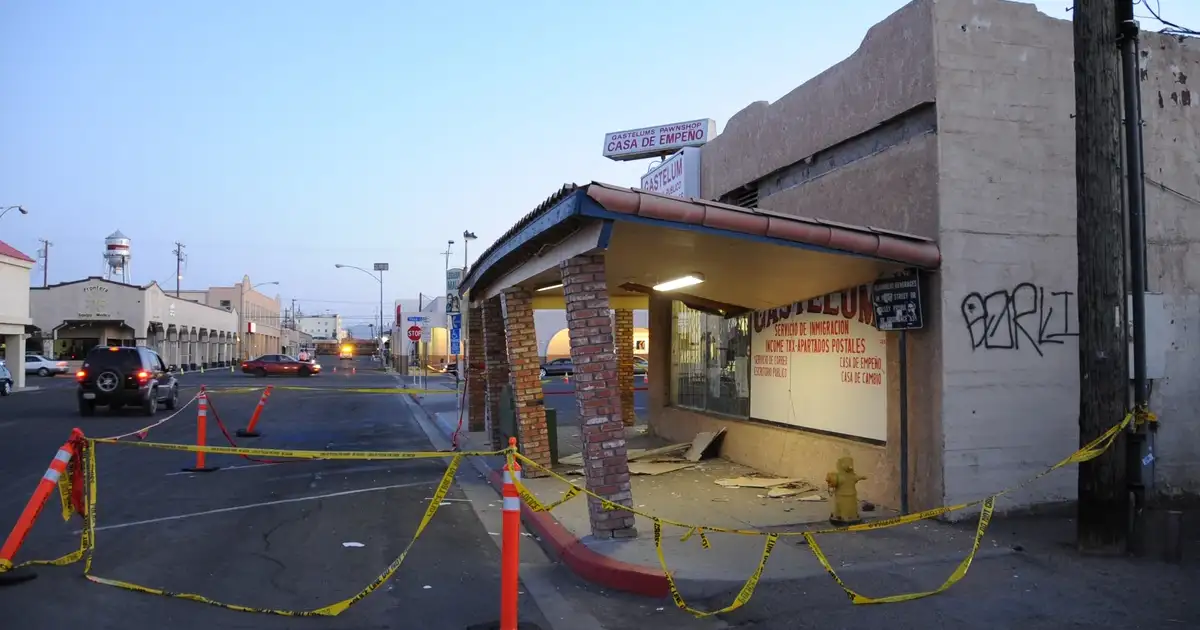

California just got a seismic gut-punch, and it’s a wake-up call louder than any stadium roar. On July 11, 2026, a magnitude 4.8 earthquake didn’t just rattle the state; it officially ‘unlocked’ the terrifying fault line that experts warn will unleash the Big One. This wasn’t some minor tremor; its epicenter near the southern end of the Salton Sea, approximately 15 miles southeast of Indio, signals a deeper, more ominous shift beneath the Golden State’s feet.
The Fault Line: A Defensive Breakthrough
This quake hit hard, a clear shot across the bow. Its jolt was felt across vast swathes of Southern California, from the bustling heart of Los Angeles to the coastal stretches of San Diego counties, with the Coachella Valley experiencing the most intense shaking.

What followed wasn’t just a series of routine aftershocks, mostly below magnitude 3.0. This sustained seismic activity is a clear indicator of profound geological shifts, directly pointing to the long-dormant southern San Andreas Fault.
This segment has been ominously silent since 1680. That’s over 340 years of built-up, unreleased tension, a pressure cooker simmering for centuries.
Seismologists are no longer just observing; they are sounding the alarm. They unequivocally link this recent activity to increased pressure on this specific fault segment.
Dr. Lucy Chen, a Caltech seismologist, didn’t mince words. While a M4.8 quake isn’t “the Big One,” its precise location in an already highly stressed region demands more than just casual monitoring. It demands immediate, strategic attention.
“Such activity can potentially influence adjacent fault segments,” Dr. Chen warned. “It’s like a domino effect waiting to happen, where one release can trigger another, larger event.”
This isn’t mere speculation; it means stress is actively shifting, potentially “unclamping” previously static sections of the fault.
This new “unlocked” status isn’t just a scientific term; it’s a tactical alert. It signifies that the defensive line has finally found a weakness, and the pocket is collapsing around California’s unprepared backfield.
California’s Seismic Time Bomb: The Clock is Ticking
The southern San Andreas Fault isn’t just a geological feature; it’s a ticking bomb, and the timer is flashing red. Experts have long estimated that a major quake (M7.0 or greater) strikes this region every 150-200 years.
We are not just past that deadline; we are deep into geological overtime. The state is playing with house money, and the odds are stacking up against it.
The Uniform California Earthquake Rupture Forecast (UCERF3) paints a grim, undeniable picture. There’s a chilling 70% chance of a M6.7 or greater earthquake hitting California within the next 30 years.
Even more terrifying, a 7% chance exists for a catastrophic M8.0 or greater quake. An “unlocked” fault doesn’t just make these numbers feel more real; it makes them feel imminent.
It’s the moment when the opposing team’s star player breaks free, and the end zone is wide open. California needs to brace for impact, not just hope for a deflection.
The Real Costs of Catastrophe: Beyond the Scoreboard
The financial hit from a major quake would be nothing short of staggering, an economic meltdown that would dwarf any state budget deficit. A hypothetical M7.8 “Big One” could unleash over $200 billion in damage.
This isn’t just a line item; it’s an economic apocalypse, a blow that would cripple the state’s vibrant economy, devastate industries, and send shockwaves through national markets. We’re talking about widespread business closures, plummeting property values, and a tourism industry brought to its knees.
But the true cost goes far beyond dollars and cents. Hundreds of thousands of people would be displaced from their homes, their lives uprooted in an instant. Thousands of fatalities are not just predicted; they are a grim certainty without adequate preparation.
This isn’t just about property damage; this is a human catastrophe on an unimaginable scale, a test of resilience that few communities are truly equipped to face.
Local residents are already feeling the anxiety, the M4.8 quake bringing “the Big One” into terrifyingly sharp focus. Who wants to invest in a disaster zone, or raise a family under the constant threat of geological upheaval?
Infrastructure planners are not just on edge; they are in a full-blown crisis. While newer buildings boast improved seismic resilience, countless older structures remain vulnerable, architectural relics waiting to crumble.
Critical lifelines — water, gas, electricity, and transportation networks like bridges and freeways — are all at severe risk. Retrofits and upgrades are not merely recommended; they are absolutely critical.
But are they happening fast enough? Is the state truly investing the necessary billions, or are we just patching holes in a rapidly decaying defense?
Governor Newsom’s Playbook: Is it Enough?
Governor Gavin Newsom issued a statement on July 12, urging all Californians to review emergency plans and secure their homes. This is the right call, a necessary first step in any crisis playbook.
But in the face of an “unlocked” fault, calls for individual preparedness, while vital, are simply not enough. This moment demands more. It demands a full-court press from state leadership, a comprehensive strategy that goes beyond rhetoric and into decisive action.
Are they truly ready for the biggest game of their lives, or are they just running out the clock?
California sits squarely on the Pacific Ring of Fire, a geological hotspot where earthquakes are not an anomaly but an undeniable fact of life.
The devastating 1906 San Francisco earthquake (M7.9) and the brutal 1857 Fort Tejon earthquake (M7.9) serve as stark historical reminders, both rupturing different segments of the San Andreas. These weren’t isolated incidents; they were previews of what’s to come, lessons carved into the very landscape of our state.
The Salton Sea area, in particular, is a known seismic hotspot, constantly experiencing swarms of smaller quakes. Seismologists monitor these tirelessly, watching for any sign that could trigger larger, more catastrophic events. This latest quake is exactly that sign.
Gus Callahan’s Take: Time to Play Hardball
This “unlocked” fault line isn’t just a geological update; it’s a game-changer. It shifts the conversation from “if” to “when.” California cannot afford to be caught flat-footed, unprepared for the inevitable.
The state’s leaders talk a good game about readiness, but are they truly executing? Are the billions needed for critical infrastructure upgrades actually being spent with urgency and strategic foresight?
Or are they simply running out the clock, hoping the Big One holds off until their term is over?
The cost of inaction is not merely astronomical; it’s unforgivable. It’s not just a financial number on a spreadsheet; it’s human lives, shattered communities, and the very fabric of California’s future.
This isn’t a scrimmage where mistakes can be brushed off. This is the championship game, and the stakes couldn’t be higher. California needs a defensive strategy that works, a robust offensive plan for immediate recovery, and the unwavering resolve to execute both.
Will the Golden State step up, lead with conviction, and play hardball against this existential threat, or will it fumble when the earth finally decides to play its toughest hand?
Source: Google News